

Transportation inflation is one of the harder concepts to explain to people outside the industry. A few weeks ago, I was talking with my father-in-law, and he asked what was going on in the world of supply chain. The first thing that came to mind, the thing I figured anyone could relate to, was simple: ocean freight costs are skyrocketing.
When ocean freight costs spike, it takes time for the outside world to feel it. So, when my father-in-law mentioned that he hadn’t heard about the rise in ocean freight costs, I was not surprised. Those costs get relayed through the chain — some are absorbed, some are passed on — and customer contracts don’t always allow prices to move in the moment.
The rough timeline is about six months. It can hit faster when demand spikes and the true bullwhip effect kicks in, but over the last five years it’s typically taken around six months before that inflation actually reaches the customer.
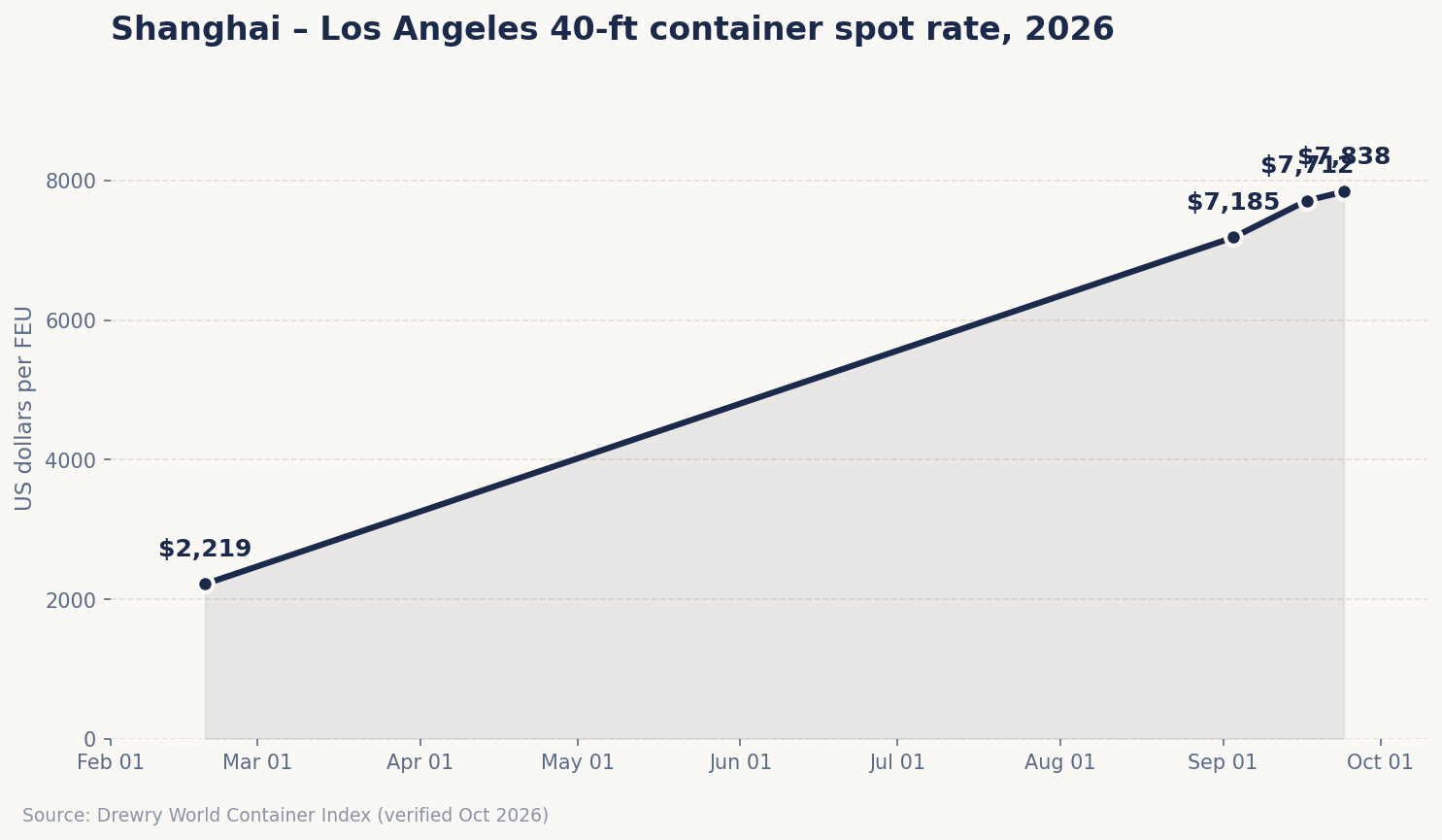
In September 2026, rates hit roughly 4x where they started the year. The surge, driven by the Iran war and the Strait of Hormuz crisis, is doing two things at once: disrupting the ocean freight market and driving inflation through rising fuel prices — basically chaos across the industry. Drewry’s World Container Index puts the Shanghai–Los Angeles 40-foot rate at roughly $2,200 in mid-February and nearly $7,800 in late September. To put that in per-pound terms: back in February it was about 5 cents a pound. In today’s market, it’s about 20 cents.
So far, the impact is limited to ocean freight spot pricing. Tariffs are a separate story.
The other piece nobody’s talking about is early ordering. U.S. importers are pulling orders forward — partly from new tariffs, partly over uncertainty in freight pricing heading into Q4. The result is an early peak season.
The mystery of global ocean freight costs isn’t my father-in-law’s alone. Keep in mind, he’s a brilliant lawyer — fifty years in a very complex field. A few weeks ago, I was talking with the CFO of a small company about the supply chain industry. The conversation centered on tariffs — then came the next big question: “What are you worried about next?” I told her without hesitation: “Global ocean freight costs.” It’s worth noting that cost and operational risk tend to trail one another.
So my final answer to my father-in-law was this: the rest of 2026 will carry a layer of inflation from ocean freight costs. Delayed, uncertain rates are causing chaos in the market, and companies are carrying extra inventory to cover the uncertainty. We tend to picture ocean freight as finished goods — smartphones and consumer products. But around 60% of the world’s crude oil travels by tanker, and global commodities like oil absorb those freight adders even when produced locally. And the Middle East remains an unknown — what do you do about that?
What’s Next?
If you’re a supply chain leader trying to avoid supply gaps and minimize EBITDA erosion, work the contracts you have today with ocean carriers — that’s your strongest lever. The next best option is alternative partners; that’s where brokers come into play. There may be options with extended lead times that cost less than the spot price, but the strategic decisions aren’t black and white here. For the normal consumer — my father-in-law, for example — this isn’t a COVID-level toilet paper scarcity discussion just yet. The operational side of the market is still functioning, so assume there will be limited changes in ocean freight for 2026. And the V-shaped demand curve from turning the faucet off and back on in 2021 was a sharper spike than what we’re seeing now. If the Middle East conflict resolves tomorrow, it will take 3–6 months for all the dominoes to fall back in line.
Sources
- Drewry, World Container Index — Shanghai–Los Angeles 40-foot container rates (figures and rate chart data)
- Reuters, “Ocean container shipping rates could test record highs on Iran war, fuel spike,” September 17, 2026 — link
- Xeneta, “Carriers seize opportunity as freight rates head towards record levels” (via World Ports) — link
- Freightos, weekly rate update, September 22, 2026 — link
- Stanford Graduate School of Business, “Why do oil tankers spend so much time sailing empty,” June 2026 — link