


As a supply chain leader, you’ve probably been inundated with AI pitches from every software vendor under the sun. These AI solutions are advertised as the answer to every supply challenge. Poor forecasting? Toss in AI. High inventory and working capital? AI will cut it by 99%. Transportation problems? AI delivers at six sigma — 99.99%.
I won’t beat around the bush: most of these pitches are reach-for-the-stars scenarios. MIT research found that 95% of generative AI pilots fail to generate any measurable return on investment. And the most important thing to remember — regardless of the supply chain function — is that garbage in means garbage out.
The Juice Wasn’t Worth the Squeeze
I’ll tell you a story about the risk of being an early adopter of new technology. Think back a mere five years — a little thing called COVID sent disruption through global supply chains. The market was rattled, and trust became a rare commodity. In the aftermath, layers and layers of safety got built into supply chains: safety forecasts, bloated buffers, entire S&OP teams planning out of fear of the next disruption. Peeling back those layers took time and patience.
One way to rebuild trust, I figured, was to pull back the curtain on the variables impacting lead time. If we could see what was actually moving our delivery dates — weather, port congestion, labor disruptions, rail embargoes, any event hitting our containers — we could plan against reality instead of padding against fear. So my team and I went looking for a software solution that could read the macro landscape and predict changes across all our ocean freight deliveries.
We evaluated the options and made the best choice for our needs. But it was too good to be true. The software wasn’t worked out, and the data was producing incorrect delivery dates — the very trust we were trying to rebuild, undermined by the tool meant to build it.
The implementation took 40% longer than expected. I had to dedicate some of my staff to the project for six months to assist with the IT install. We ended up with something usable — but the juice wasn’t worth the squeeze.
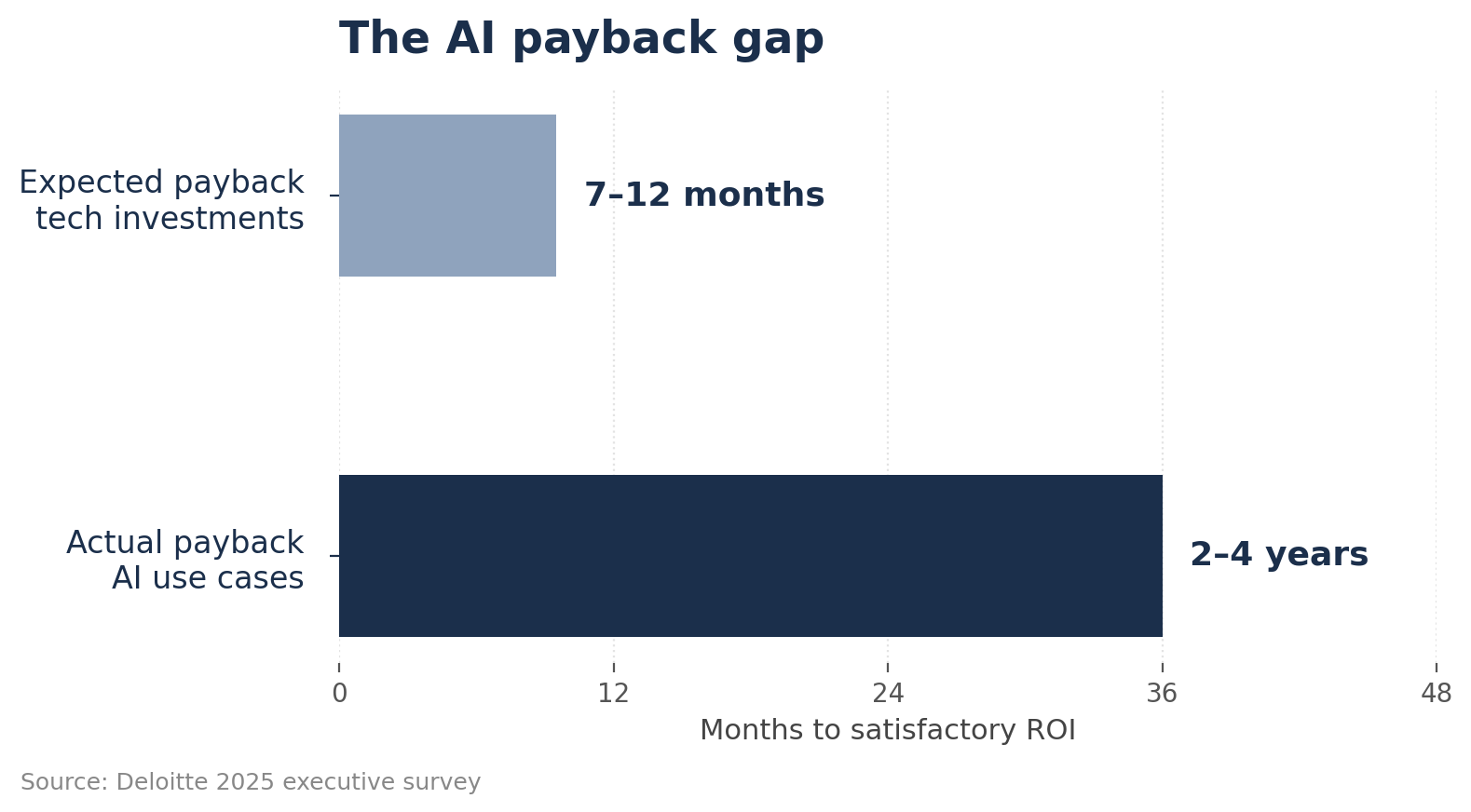
Here’s what I took away from it. First, the vision was right but the timing was wrong — being early means paying the implementation tax. Second, the data has to be right or nothing else matters; a predictive tool fed on bad inputs just produces confident wrong answers faster. Third, these installations demand a real launch team and a long runway: Deloitte’s 2025 survey found most organizations see satisfactory ROI on a typical AI use case only within two to four years, far longer than the 7 to 12 months usually expected from technology investments.
If You’re Going to Do It Anyway
So if you’re going to do this anyway, do it with your eyes open.
If you do decide to pursue AI for your supply chain, here are a few pointers. First, the terminology. You’ll hear the terms “agents” or “agentic” — think of these like your workers. Agents handle individual tasks: demand planning, customer service, production scheduling, or other roles within the operations ecosystem.
Second, don’t try to boil the sun. Pick an area your team understands well, with a strong case for payback and agreement from your broader teams. If you choose demand planning and forecasting, I’d recommend finding a small segment of the portfolio to focus on. Get a win first, then expand the scope.
Third and final: find a reputable software company with a track record of launching AI solutions in supply chain. Look at ERP and traditional S&OP providers, but don’t ignore the smaller players — in some cases a smaller provider can dedicate more resources to tailoring a solution. The agents aren’t free, so make sure your money is going to good use.
Where AI Earns Its Keep
To be fair, the technology isn’t worthless — it’s just oversold. Where I’ve seen it genuinely help is in spotting what humans miss: anomalies buried in demand patterns, early warnings hidden in noisy data, the kind of signal detection that used to take a team of analysts weeks to surface. The problem was never the math. It was everything around the math — the data going in, the people running it, and the patience to wait for the payback.
The Verdict
Will AI actually tame the bullwhip? The answer is unknown — but a good system can get pretty close. Think of it this way: the bullwhip exists because of variability in the supply chain. AI tries to predict that variability, respond to it, and eventually learn from it to prevent it in the future.
But here’s what the pitch decks leave out: the bullwhip was never just a forecasting problem. It’s batching, incentives, lead times — human decisions compounding as they move upstream. AI can sharpen the signal, but no algorithm fixes a system people keep distorting. Get your data clean, your processes honest, and your expectations modest. Then let the machine do what it does best.
Sources
- MIT, State of AI in Business, 2025 — 95% of generative AI pilots fail to generate measurable ROI
- Deloitte, 2025 executive survey — satisfactory ROI on a typical AI use case within two to four years, vs. 7–12 months expected for technology investments